
The Thinking Is the Work: What Agentforce World Tour DC Revealed About Where Value Is Going
The question isn't whether agentic AI is going to change how your organization uses Salesforce. It will. The more useful question — and the one I went to Washington D.C. to think about — is how values shift when it does. Technology doesn't make those choices for us. We do.
Agentforce World Tour DC gave me a lot to work with. The event opened with a full-day Military AI Summit, organized by Tom House and Josh Mendez at Salesforce Military in partnership with Hiring Our Heroes. It brought together over 130 executives, military leaders, and industry partners at the intersection of military talent and the future of AI. Blue Star Families debuted their STAR Agent, powered by Agentforce, showing in concrete terms how this technology can serve military families. Major General Hope Rampy was in the room to talk about Army’s HR on Salesforce. So was 19th Chief Master Sergeant of the Air Force JoAnne Bass — the first woman to hold the highest-ranking enlisted position in any branch of the U.S. military. If you know me, you know this was a major fan-girl moment for me.
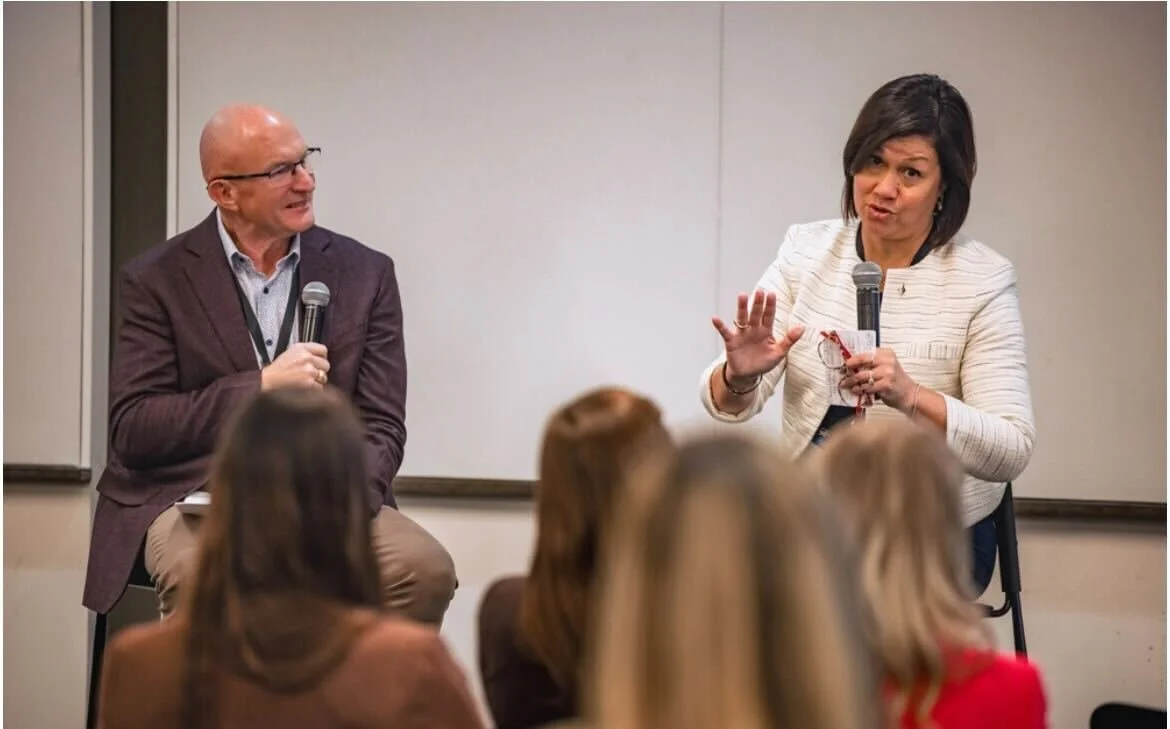
Dean Robison, SVP of Salesforce, with JoAnne Bass, 19th Chief Master Sergeant of the Air Force
There are over 40,000 Veterans Service Organizations (VSOs) across the United States, each with its own mission and community. Many of the people behind them were present and accounted for in DC — which tells you something about the moment we're in.
In the middle of all that, the World Tour stopped to recognize Bill Kuehler of Resource Hero with a Golden Hoodie.
If you don't know Bill, that's partly by design. He's the founder of Military Trailblazer Office Hours — a resource he built because transitioning veterans needed help navigating the Salesforce ecosystem and he saw the gap and decided to fill it. No announcement. No campaign. He just started showing up, week after week, and kept showing up. In the military community, there's a term for people like Bill: the silent professional. Someone who sees what needs doing, steps in, and does the sustained, unglamorous work — without waiting to be asked, and without needing the recognition.
Watching him receive that Golden Hoodie in a room that understood exactly what it represented was the moment the whole week came into focus for me.
Because everything I observed in DC points to the same underlying truth: in the agentic era, the foundational work matters more than ever. The organizations — and the people — willing to do it consistently, over time, without shortcuts, are the ones who will be standing when the dust settles.
Here's what I mean.
The interface is shifting. Is your organization ready to “pick up the Slack”?
One of the clearest signals from this event — reading between the lines of demos, conversations, and a few telling almost-slips from people on the inside — is that the future of Salesforce is not everyone logging into Salesforce.
The future is most people never opening a browser tab, because the work is coming to them through Slack.
Agentforce automation, process triggers, approvals, notifications — increasingly, these will surface in Slack. The integration between Salesforce and Slack that's been building for years is becoming something qualitatively different: Slack as the primary interface for how organizations interact with their data and automated workflows.
The practical implication is worth saying plainly: organizations that have adopted Salesforce but treated Slack as optional are going to find themselves increasingly disconnected from where the real efficiency gains are. Projects that don't include a Slack component are going to feel incomplete faster than their teams expect. This isn't a distant concern. The direction is already clear, and it's time to get ahead of it.
The most important moment of the week was a hand-drawn diagram on a clipboard.
During one of the Agentforce demos, a presenter held up a piece of paper. Hand-drawn. A box-and-arrow process sketch — the kind produced in conference rooms every day. They pointed a camera at it. Within minutes, Agentforce had read it and generated a structured, multi-step workflow with specific agents assigned to each task.
I took a photo.
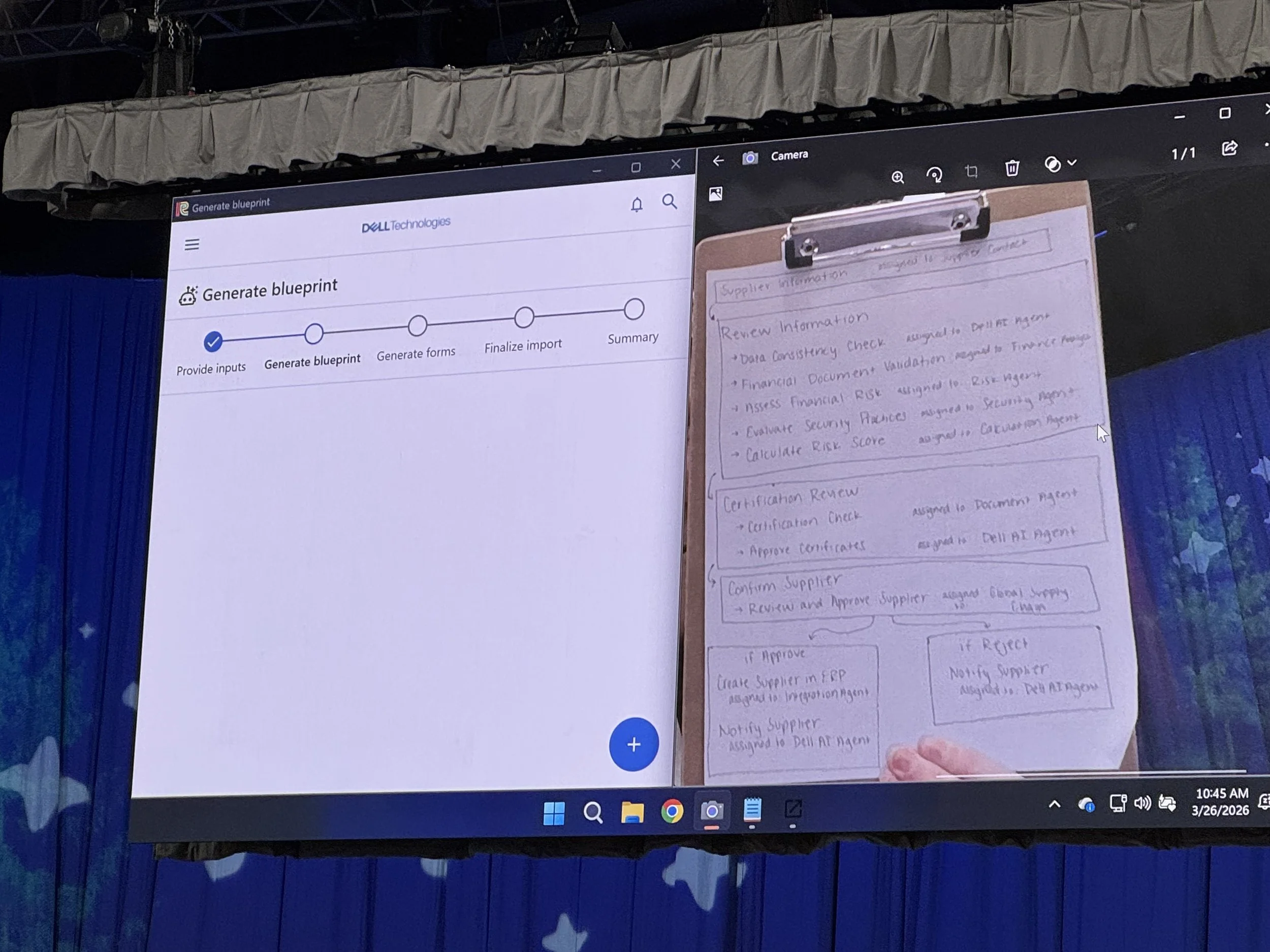
The clipboard shows a hand-drawn supplier onboarding flow — supplier information, financial document validation, risk assessment, certification review, approval and rejection branches. Beside it, the "Generate Blueprint" interface has already begun turning it into a structured workflow.
Yes, these are demo conditions. Real-world results will be messier. But the direction it points is unmistakable — and I think it's being misread.
The anxious interpretation is: if AI can build the process, what's left for Salesforce folks to do?
Look at that drawing again. That's not a simple sketch. It represents a supplier onboarding process — who reviews what, who approves what, what happens when something is rejected, which agent handles which task. Somebody had to think that through. Somebody had to sit with the people who own that process, surface the edge cases, map the decision points, and produce something scoped correctly and structured in a way Salesforce can actually act on.
That is the work. It always was.
AI doesn't change what it takes to reach an accurate, agreed-upon business process. If anything, it raises the stakes — because now a well-drawn picture is the direct input to something that builds fast. The quality of the thinking upstream determines everything about the quality of what gets built downstream.
We can no longer rely on the natural friction of a development process to ensure that what we’re building makes sense. We have to get it right on the front end.
For mission-driven organizations, this is both a challenge and a genuine opportunity. The organizations that invest in process clarity now — that document their workflows, articulate the intent behind their systems, build the institutional knowledge that AI needs to act — will benefit most from what's coming. The ones that skip that work won't find a shortcut – just faster ways to build the wrong thing.
Values Meet the Moment
Bill Kuehler has been doing the quiet, foundational work for years because he understood, intuitively, that it was what mattered — long before anyone was going to hand him a Golden Hoodie for it. That kind of sustained, patient commitment to doing the right thing the right way? That's not a personality quirk. It's a strategy. And it's about to look very prescient.
The agentic era will reward clarity, documentation, and deep process knowledge. It will reward the organizations — and the people — who did the thinking before it became obvious that the thinking was the point.
Because… it always was.
BrightHelm Partners works with nonprofits, veterans service organizations, faith-based institutions, and mission-driven teams to implement and optimize Salesforce. If you're thinking through what the agentic era means for your organization, we'd love to talk.