At the end of the call where Hayley offered me this job, she said there was one more thing to show me and pulled up BrightHelm's knowledge base. Every article sat under a numbered map. A series for training, a series for marketing, a series for delivery. She told me it was going to look familiar, and it did. Somebody had taken the way the Navy numbers its instructions and run a whole Salesforce consultancy on it.
There's just one small problem with that.
I'm Army.
Plucky, one of BrightHelm's mascots, has already noted this and poured me a coffee anyway.
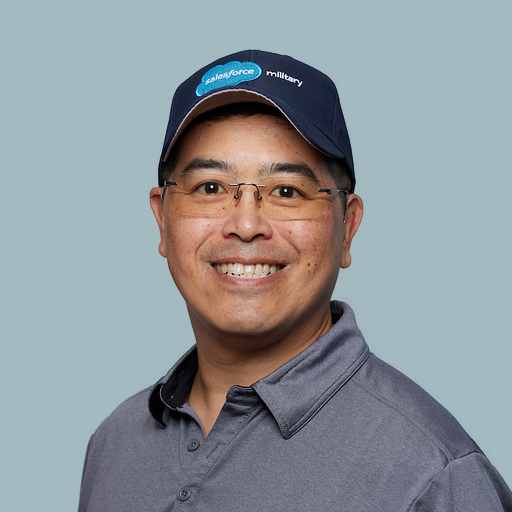
So, introductions. I'm Larry, BrightHelm's newest Declarative Developer and the latest addition to the crew. (See? I'm learning.) Hayley asked me to tell you who I am and how I got here. The short version is that it took a while.
Thirty Years in the Army
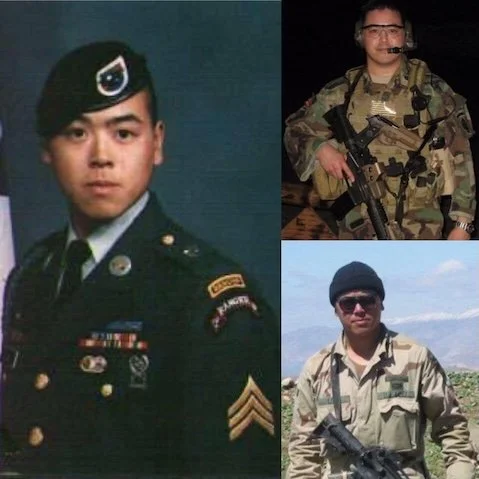
I served thirty years in the Army, from 1991 to 2022, and retired as a Lieutenant Colonel. I spent much of that time in military intelligence. I served with the 1st Special Forces Group and the 173rd Airborne Brigade, coached Special Forces intelligence teams at Fort Polk, advised the Royal Saudi Land Forces in Tabuk, and deployed to Monrovia, Liberia, during the 2015 Ebola response. I was Executive Officer of a 1,600-soldier chemical brigade spread across 10 installations, then a Military Strategic Planner at U.S. Central Command, with a stretch in Kabul advising the Afghan Ministry of Interior's counterterrorism police.
The day I remember best is May 9, 2015. My brigade headquarters had taken over the U.S. mission in Liberia that March, and my job was bio-surveillance intelligence: helping track where the outbreak was going, working with U.S. government and Liberian organizations, assessing whether the response was actually working, and recommending next steps to Liberian ministry leaders.
That day I was sitting in the main conference room with Liberia's President when the World Health Organization announced the country was free of Ebola. It had been 42 days since the last confirmed case. More than 4,700 people had died there.
The room exploded with cheers. I walked out thinking what a wonderful feat the Liberians and the people working alongside them had pulled off, and hoping it would last.
Two things came with me out of the Army, and neither one is on a ribbon rack.
The first is briefing: explaining a decision to someone who doesn't want all the details, which turns out to be most of consulting. The second is writing down what you did so the next person can pick it up.
One thing did not come with me. In the Army, when something is ambiguous, there's a chain of command to resolve it. In consulting, nobody is coming. You have to go ask the client.
My Salesforce Story
I started working on my exit in 2021, with a Hiring Our Heroes fellowship at Sales Platoon, where I trained as an account executive, and FourBlock's career readiness program.
Along the way, a buddy of mine who was also on the retirement journey suggested I take a look at Salesforce and jump on Trailhead. I did, and I was hooked. I started looking for anything that would help me understand what a Salesforce Admin actually does and needs to learn.
Then I heard about the Hiring Our Heroes Salesforce Fellowship Program, which places transitioning veterans and military spouses as fellows at a variety of companies. The catch was that I needed my Admin cert first. That's what brought me to Merivis, which runs training cohorts for veterans and military spouses getting into the Salesforce ecosystem. I was still just figuring out what a post-military career could look like. I passed the Admin exam on my second attempt.
When Merivis asked for volunteers to mentor its next Admin cohort, I jumped at the chance to give back.
I applied to the Hiring Our Heroes Salesforce fellowship and was accepted as a candidate, alongside many of the people from my Merivis cohort. After interviews with a few companies, I didn't make the cut as a fellow. What got me in the door was my military network. A Merivis connection helped me get a third interview with eVerge Group, now part of Alithya, and in February 2023 they hired me directly as a Salesforce Consultant.
I had three great years of learning there. I worked on more than ten client engagements, wearing whatever hat each one needed: QA, business analyst, Scrum Master, Jira owner, interim project manager.
Outside of client work, I kept studying. Today I hold eight Salesforce certifications and have finished 52 Superbadges, and if you ask me, the Superbadges are the better teacher. A certification asks you to recognize the right answer out of four. A Superbadge makes you build the thing. It also earns you a slice of cheesecake, which is a rule I made up and have no plans to change.
Then, in February 2026, I found out from HR that my role had been eliminated in a layoff. My heart dropped. Anxiety crept in as I started thinking about how to support my family. I told myself that with all this experience under my belt, it should be easy to land something right away.
Wrong.
It took about eight months of job searching and reaching out to my Salesforce network.
I used the time. I scheduled informational interviews, applied to many places, and built in a dedicated org to get deeper in Experience Cloud. I also started preparing for the Data Cloud Consultant exam. I'd wanted more time building anyway.
I also kept showing up. I'd been named Merivis Alumni of the Year the September before, and I kept mentoring transitioning service members who came to me for help and attending Military Trailblazer Office Hours. That made for a strange eight months: telling people how to break into this ecosystem while looking for my own way back in.
Why BrightHelm?
Hayley was in my network. She found out in the Military Trailblazers Slack channel that I was looking for work and recommended I check out another company, so I applied. Then she reached out again, this time to pitch BrightHelm, and I thought it was a great fit. I noticed the order of those two conversations: she tried to help me first and recruit me second.
When Hayley made the offer, I said up front that I hadn't done nonprofit work yet. She wasn't worried about it. Then she told me to take some time and talk it over at home. I said I'd need to run it by Household Six (my wife), which is Army-speak for the person actually in charge.
Household Six concurred.
I said yes for three reasons.
The mission is one I care about. BrightHelm is veteran-owned, and its work is with nonprofits and veteran-serving organizations. After a career in uniform, that's where I want my configuring to go.
The discipline is familiar. Things get written down. Skills get signed off by someone qualified, just like a qual. Collateral duties are real, and if you see something that needs doing, you pick it up. Hayley was also direct with me about everything, including the hard parts, and that's rarer than it should be.
And the crew is growing. More mission-driven organizations keep finding BrightHelm, and I came here to build, get my reps, and help carry that work.
I'm working through my quals now. That's the Navy word. I'm told I'll get used to it. In fairness, the Army numbers its staff sections the same way: S-1 for personnel, S-3 for operations, S-4 for logistics. So I wasn't entirely lost when I saw those maps.
I did have to read one twice, though. In the Navy, N4 is logistics. At BrightHelm, the 4-series is marketing, which means this blog post is technically a resupply.
You're welcome.
If you're transitioning out of the service and wondering whether Salesforce is for you, find me on LinkedIn. A buddy pointed me to Trailhead, and a Merivis connection got me my third interview, and a fellow Military Trailblazer from the community hired me, so I owe a few of those. And if you're at a mission-driven organization looking for help with Salesforce, let's talk. Your mission, our map.